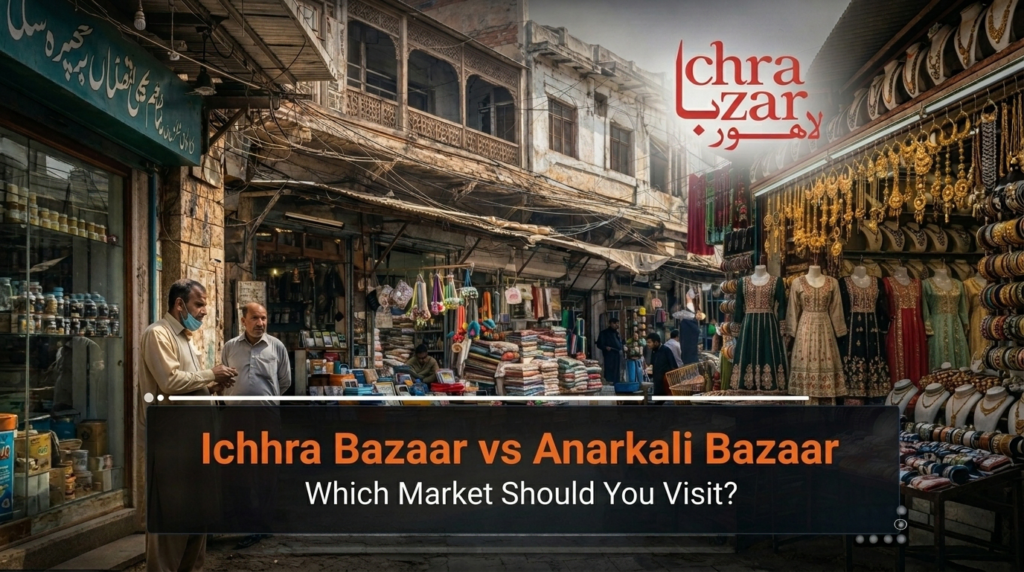
Ichhra Bazaar and Anarkali Bazaar are Lahore’s two most frequently compared traditional markets and the comparison almost always produces the wrong conclusion because most buyers ask the wrong question. The question is not which market is better. The question is which market is better for what you are buying, on what budget, from which part of Lahore, and with how much time. The answer is different for every combination of those four variables, and a buyer who visits the wrong market for their specific purchase walks away either overpaying or leaving with a narrower selection than they needed.
Ichhra Bazaar is Lahore’s most price-competitive fashion retail market located on Ferozepur Road in the city’s western commercial district, with over 2,000 shops concentrated across interconnected fabric, footwear, jewellery, and clothing lanes. Anarkali Bazaar is one of South Asia’s oldest surviving markets located on Mall Road in central Lahore near Lahore Railway Station, divided into Old Anarkali (Lahore’s most famous food street) and New Anarkali (traditional handicrafts, clothing, and jewellery). Both markets bargain. Both carry unstitched fabric, women’s suits, and jewellery. Both draw buyers from across Lahore and beyond Punjab. What they do differently in pricing structure, product specialization, market atmosphere, location accessibility, and occasion suitability is what this comparison covers in complete detail.
This article compares Ichhra Bazaar and Anarkali Bazaar across five dimensions: price, product variety, shopping experience, location and accessibility, and occasion suitability. Each dimension has a data-supported verdict. The article closes with a structured verdict table and a buyer decision guide that tells you specifically which market to choose based on what you are buying and your situation so you visit the right market the first time.
Ichhra Bazaar vs Anarkali Bazaar: Understanding What Each Market Actually Is
Before comparing the two markets directly, understanding what each market was built for and what it has evolved to serve prevents the most common comparison mistake: treating them as two versions of the same thing.
What Ichhra Bazaar Is Built For
Ichhra Bazaar is a fashion-first retail market. The overwhelming majority of its 2,000-plus shops deal in a single macro-category: clothing, fabric, and fashion accessories. The market has no significant non-fashion commercial presence; it does not carry the electronics, books, or antiques that appear in Anarkali Bazaar’s wider product ecosystem. This single-category concentration means that every vendor in Ichhra Bazaar competes against adjacent vendors selling the same product type, which creates the sustained price pressure that makes Ichhra Lahore’s most affordable retail fashion destination. The market’s identity is built on price competitiveness, fabric variety, and purchasing efficiency. A buyer who knows what fabric type and quality tier they want can complete a focused purchase in Ichhra Bazaar faster than in any other traditional market in Lahore.
What Anarkali Bazaar Is Built For
Anarkali Bazaar is a cultural and commercial ecosystem, one of the oldest surviving markets in South Asia, with a history extending over 200 years and a physical structure that reflects both Mughal-era commercial patterns and British colonial-era development. The bazaar was listed on the World Monuments Watch in 2020 by the World Monuments Fund, recognizing its historical and cultural significance alongside its endangered status due to infrastructure neglect. Anarkali Bazaar’s product range is significantly wider than Ichhra Bazaar’s; it carries traditional handicrafts, antique-style jewellery, clothing, bridal wear, books, leather goods, and food in a single market ecosystem. The market’s identity is built on variety, historical atmosphere, and the specific cultural authority that comes from being Lahore’s oldest commercial hub. Buyers visit Anarkali Bazaar for things that are either unavailable or narrowly available elsewhere, particularly traditional handicrafts and antique-style jewellery rather than for price-competitive everyday fashion.
Structurally, Anarkali Bazaar divides into two distinct sections with separate commercial identities. Old Anarkali is Lahore’s most famous food street concentrated with street food vendors, traditional restaurants, and sweet shops that draw visitors independently of the shopping. New Anarkali is the commercial shopping section, containing sub-markets including Bano Bazaar, Dhani Ram Road, Jan Muhammad Road, Aabkari Road, Urdu Bazaar, and Paan Gali each with its own product specialization within the broader clothing and accessories category.
Price Comparison: Ichhra Bazaar vs Anarkali Bazaar Which Market Is Cheaper?
Price is the most searched comparison dimension between these two markets and the one with the most nuanced honest answer. Neither market is uniformly cheaper than the other across all categories but the price leadership is clearly differentiated by product type.
Unstitched Fabric and Suits: Ichhra Bazaar Wins
For unstitched fabric and 3-piece suit sets the highest-volume purchase category in both markets Ichhra Bazaar consistently prices below Anarkali Bazaar for equivalent quality. A mid-range digital-printed lawn 3-piece in Anarkali Bazaar prices at PKR 2,500 to PKR 4,500 depending on embroidery weight. The same specification in Ichhra Bazaar prices at PKR 2,200 to PKR 4,000 from established shops, and PKR 1,800 to PKR 3,200 from stall vendors, a consistent 15 to 25 percent price advantage across the mid-range fabric tier.
The mechanism behind this differential: Ichhra Bazaar has a higher vendor density in the unstitched fabric category than Anarkali’s New Anarkali section. More vendors selling the same product on the same lane creates more intense price competition that pushes transaction prices closer to the wholesale floor. Anarkali Bazaar’s fabric section is part of a wider multi-category market where fabric vendors face less immediate competition from adjacent sellers in the same category.
| Category | Anarkali Bazaar Price Range | Ichhra Bazaar Price Range | Price Advantage |
| Unstitched lawn 3-piece (economy) | PKR 2,000 – PKR 3,500 | PKR 1,800 – PKR 3,200 | Ichhra by 10–15% |
| Unstitched lawn 3-piece (mid-range) | PKR 3,500 – PKR 5,500 | PKR 3,000 – PKR 4,800 | Ichhra by 12–20% |
| Stitched women’s suits | PKR 3,000 – PKR 5,000 | PKR 2,500 – PKR 4,500 | Ichhra by 10–15% |
| Khaddar 3-piece (winter) | PKR 2,500 – PKR 4,500 | PKR 2,800 – PKR 5,500 | Roughly equal |
| Chiffon / party wear | PKR 4,000 – PKR 8,000 | PKR 3,500 – PKR 8,500 | Roughly equal |
Verdict on fabric pricing: Ichhra Bazaar wins particularly on lawn and everyday cotton, where the price advantage of 12 to 20 percent is consistent and repeatable across quality tiers.
Jewellery and Traditional Accessories: Anarkali Bazaar Wins on Variety, Ichhra on Volume Pricing
Anarkali Bazaar’s jewellery and handicraft section within New Anarkali particularly along Bano Bazaar and Paan Gali carries a wider range of traditional jewellery styles, antique-inspired pieces, and handcrafted accessories than Ichhra Bazaar’s jewellery lane. However, Ichhra Bazaar’s jewellery vendor density is higher in the costume jewellery and bangles segment meaning more competition and more negotiating room on everyday jewellery purchases.
For traditional antique-style jewellery, handcrafted silver work, and culturally specific pieces tied to Lahore’s handicraft heritage, Anarkali Bazaar offers both greater variety and greater authenticity than Ichhra’s fashion-jewellery focused stock. For bridal costume sets, everyday bangles, and contemporary gold-plated sets at competitive prices, Ichhra Bazaar’s higher vendor density produces better negotiated outcomes.
Street Food: Anarkali Bazaar Wins Comprehensively
This is not a close comparison. Old Anarkali Bazaar is one of Lahore’s most celebrated food destinations with historic vendors including Nasir Bong Paye, Saleem Butt’s Mutton Channay, Ghosha-e-Shireen’s halwa puri, and Amal Desserts operating in a dedicated food street that draws visitors independently of any shopping purpose. Ichhra Bazaar has active street food stalls including the well-known Shahi Pathoora puri shop and dahi bhalla vendors near the market entrance but at a fundamentally smaller scale and with less culinary depth than Anarkali’s dedicated food street.
Overall price verdict: Ichhra Bazaar wins on fashion and fabric pricing. Anarkali Bazaar wins on traditional handicraft and antique jewellery authenticity. Food pricing is not a meaningful differentiator; both markets operate on similar street food economics.
Product Variety Comparison: What Each Market Carries That the Other Does Not
Product variety is where the two markets diverge most clearly and where the “it depends on what you are buying” verdict is most precisely demonstrated.
What Ichhra Bazaar Carries That Anarkali Does Not (or Not as Well)
Fabric variety depth: Ichhra Bazaar’s unstitched fabric section spans hundreds of dedicated fabric shops organized by category lawn specialists, khaddar specialists, chiffon vendors, and karandi/linen shops in a concentration that makes side-by-side design and quality comparison practical within a single visit. Anarkali Bazaar carries fabric but not at this category depth or vendor density. A buyer who wants to compare fifteen different mid-range khaddar designs before committing to a purchase has a significantly better comparison environment in Ichhra Bazaar than in Anarkali.
Price-tier accessibility: Ichhra Bazaar’s economy tier, the lowest available price point for each fabric category, goes lower than Anarkali’s equivalent, because Ichhra’s stall-vendor segment is larger and more competitive. Economy cotton suits starting at PKR 1,500 and economy lawn 3-pieces starting at PKR 1,800 are consistently available in Ichhra Bazaar from open-table stall vendors; equivalent price points are harder to find in Anarkali’s New Anarkali section.
Footwear selection: Ichhra Bazaar has a dedicated footwear section with higher vendor density in embroidered khussa, casual ladies’ sandals, and everyday footwear than Anarkali’s equivalent. For footwear purchases at Ichhra’s price range, the selection and competition within the market is stronger.
What Anarkali Bazaar Carries That Ichhra Does Not (or Not as Well)
Traditional handicrafts and antique-style goods: Anarkali Bazaar’s handicraft vendors particularly in the New Anarkali section along Bano Bazaar carry hand-embroidered traditional items, pottery, woodwork, leather goods, and antique-inspired decorative pieces that have no equivalent in Ichhra Bazaar’s fashion-focused inventory. These categories attract buyers specifically looking for authentic Lahore craftsmanship rather than fashion retail.
Books and educational materials: Urdu Bazaar within the Anarkali ecosystem is Lahore’s primary book market for new and used books across Urdu literature, academic texts, and general reading. This category is entirely absent from Ichhra Bazaar.
Historical architecture and cultural context: Anarkali Bazaar’s physical environment Mughal-era and colonial-era buildings, narrow heritage lanes, the proximity of the Lahore Museum, Lahore Fort, and Badshahi Mosque provides a cultural shopping experience that Ichhra Bazaar’s more modern commercial layout does not replicate. Buyers who combine shopping with historical sightseeing find Anarkali Bazaar’s location significantly more rewarding.
Bridal handicraft accessories: Anarkali Bazaar’s bridal accessories section particularly handcrafted jewellery, embroidered bridal dupattas from specialist vendors, and traditional bridal accessories tied to Lahore’s craft heritage has a depth and authenticity that Ichhra Bazaar’s bridal section, focused more on ready-made bridal wear and fashion jewellery, does not fully replicate.
Shopping Experience Comparison: Crowd Density, Navigation, and Atmosphere
Crowd Density and Navigation Difficulty
Both markets are dense and require significant on-foot navigation but the nature of that density differs in ways that affect the shopping experience meaningfully.
Ichhra Bazaar’s lane structure is complex but navigable by product category. Once a buyer understands that the fabric section, bridal lane, jewellery section, and footwear block occupy distinct areas within the market, navigation becomes purposeful, entering the correct section for the intended purchase and comparing across vendors within that section. The main challenge in Ichhra Bazaar is finding the bridal lane and jewellery section on a first visit, as they are not visible from the Ferozepur Road frontage and require navigating through the fabric section to reach.
Anarkali Bazaar’s navigation is more complex for first-time visitors because its sub-markets Bano Bazaar, Urdu Bazaar, Paan Gali, and others within New Anarkali each have different product specializations that are not obvious from the market’s main entrance. A buyer looking for a specific product category in Anarkali Bazaar without prior knowledge of which sub-market carries it will spend significantly more time navigating than in Ichhra Bazaar’s more product-concentrated layout.
Both markets are at their most crowded on weekends and in the weeks before Eid-ul-Fitr and the October-November wedding season. Anarkali Bazaar additionally draws a significant tourist and sightseeing visitor population particularly on weekends and public holidays which adds a non-shopping crowd layer that Ichhra Bazaar, as a more locally-focused market, does not experience.
Bargaining Culture
Bargaining is expected and standard in both markets. Neither market uses fixed pricing as the default negotiation is the transactional mechanism across all product categories in both Ichhra Bazaar and Anarkali Bazaar. The markup structure differs slightly between the markets: Ichhra Bazaar’s higher vendor density in fabric and fashion creates more immediate cross-vendor competition that buyers can use as leverage, while Anarkali Bazaar’s more diverse product categories mean some specialist vendors particularly in handicrafts and antique jewellery hold firmer on pricing because their items have fewer direct comparators within the same market.
Atmosphere and Sensory Experience
This is where the markets diverge most dramatically in character rather than commercial function. Ichhra Bazaar’s atmosphere is high-energy, commercially focused, and fast-paced the dominant sensory experience is the visual density of fabric displays, vendor calls, and the constant movement of shoppers navigating between lanes. The market exists to facilitate fashion purchases efficiently, and its atmosphere reflects that commercial purpose.
Anarkali Bazaar’s atmosphere is layered shopping, food, history, and cultural tourism coexist in the same physical space. The narrow lanes of New Anarkali carry Mughal and colonial-era architectural remnants above the commercial shop fronts. Old Anarkali’s food street adds the aromas and sounds of one of Lahore’s most active culinary destinations. For buyers who want shopping to be part of a larger cultural experience rather than a focused purchasing mission, Anarkali Bazaar provides an environment that Ichhra Bazaar does not attempt to replicate.
Location and Accessibility Comparison: Which Market Is Easier to Reach
Location in Lahore’s Geography
Ichhra Bazaar and Anarkali Bazaar serve different geographic catchment areas within Lahore which means that for many buyers, the accessible market is already determined by their home location before any product comparison is made.
Ichhra Bazaar on Ferozepur Road serves western and southwestern Lahore Gulberg, Johar Town, Township, Samanabad, DHA Phases 1 to 3, and Cantt areas all access Ichhra more efficiently than Anarkali. Ferozepur Road is one of Lahore’s main arterial routes, making Ichhra directly accessible from these areas without requiring entry into central Lahore’s more congested traffic zones.
Anarkali Bazaar on Mall Road near Lahore Railway Station serves central and eastern Lahore areas including the Walled City, Gulshan-e-Ravi, Iqbal Town, and areas near Lahore’s historic centre access Anarkali more naturally. Anarkali’s central Mall Road location also makes it more accessible from Lahore Railway Station buyers arriving in Lahore by train find Anarkali within five minutes by rickshaw of the station, making it the practical first stop for inter-city visitors.
Public Transport Access
Anarkali Bazaar has the stronger public transport connection of the two markets. The Lahore Metro Bus Red Line has a dedicated Anarkali stop that drops passengers directly at the market entrance, a significant convenience advantage for buyers using public transport. Metro Bus access eliminates the parking problem entirely for buyers who plan around it.
Ichhra Bazaar is served by local bus routes along Ferozepur Road and by the Metro Bus at the Qainchi stop, which requires a short additional journey to reach the market entrance. Ride-sharing services serve both markets effectively, but for pure public transport convenience, Anarkali Bazaar’s dedicated Metro Bus stop is a clear advantage.
Parking
Both markets have severely limited legal parking this is a shared disadvantage rather than a differentiating factor. Anarkali Bazaar’s Mall Road location means private vehicles face Lahore’s most congested central traffic environment in addition to parking scarcity. Ichhra Bazaar’s Ferozepur Road frontage offers slightly more accessible early-morning parking (before 11 AM on weekdays) than Anarkali’s central Lahore location. For both markets, ride-sharing or the Metro Bus is the recommended transport for all visits after mid-morning.
Operating Hours
Anarkali Bazaar generally operates from 10 AM to 10 PM, giving it a one-hour evening advantage over Ichhra Bazaar, which closes at 9 PM. For buyers shopping after work or in the evening, Anarkali Bazaar’s extended hours are a practical advantage. Both markets are open seven days a week, including Sundays.
Occasion Suitability Comparison: Which Market Wins for Your Specific Purchase
This is the dimension that most directly answers the “which market should I visit” question and the one that produces the clearest, most actionable verdicts by purchase type.
Daily Wear and Everyday Fashion: Ichhra Bazaar Wins
For everyday unstitched suits, casual cotton fabric, basic lawn, and ready-made everyday women’s suits, Ichhra Bazaar is the correct choice. The price advantage at the economy and mid-range tier is consistent, the variety within each fabric category is wider, and the purchasing efficiency of finding, comparing, and buying everyday fashion is higher in Ichhra’s more concentrated single-category market structure. A buyer whose primary need is everyday wearable fashion at the lowest available retail price in Lahore should go to Ichhra Bazaar.
Bridal Shopping: Split Verdict
Bridal shopping is the one purchase category where neither market wins comprehensively and where combining both markets produces the best outcome.
Ichhra Bazaar wins on bridal ready-made wear embroidered lehengas, shararas, and bridal gharara sets at prices 25 to 40 percent below boutique retail. The bridal lane in Ichhra Bazaar’s inner market carries a wide range of ready-made embroidered bridal sets at PKR 8,000 to PKR 25,000 for standard formats.
Anarkali Bazaar wins on handcrafted bridal accessories, traditional jewellery, embroidered bridal dupattas from specialist vendors, and handicraft bridal items that carry the cultural authenticity of Lahore’s historic craft tradition. Brides who want their accessories to carry genuine artisanal character rather than fashion-market production should source these items specifically from Anarkali.
The optimal bridal shopping strategy for Lahore: purchase the embroidered bridal suit and ready-made occasion wear from Ichhra Bazaar’s bridal lane, then source traditional bridal accessories and jewellery from Anarkali Bazaar’s Bano Bazaar and handicraft section in a separate visit.
Traditional Handicrafts and Antique Gifts: Anarkali Bazaar Wins Comprehensively
For traditional Pakistani handicrafts, antique-style items, hand-embroidered textiles, leather goods, and culturally significant gift items, Anarkali Bazaar has no equal among Lahore’s traditional markets. Ichhra Bazaar does not carry these categories. A buyer looking for authentic Lahore craftsmanship as a gift or personal purchase should go to Anarkali Bazaar’s handicraft section specifically Ichhra Bazaar cannot substitute for this need.
Budget Shopping with Maximum Price Pressure: Ichhra Bazaar Wins
A buyer whose primary constraint is budget maximum variety at minimum price across fashion categories should choose Ichhra Bazaar. The combination of higher vendor density, lower economy-tier price floors, more intense cross-vendor competition, and a fashion-focused market structure that makes cross-vendor price comparison easy gives Ichhra Bazaar the clear advantage for price-maximizing shopping.
Cultural and Historical Sightseeing Combined with Shopping: Anarkali Bazaar Wins
A buyer who wants shopping to be part of a cultural experience visiting Lahore’s historic sites, eating at the famous food street, and browsing a market that reflects 200 years of the city’s commercial heritage will find Anarkali Bazaar significantly more rewarding than Ichhra Bazaar. Anarkali’s proximity to Lahore Fort, Badshahi Mosque, the Lahore Museum, and the Walled City makes it a natural cultural itinerary anchor. Ichhra Bazaar serves commercial purchasing efficiently; it does not serve cultural tourism.
Out-of-City Visitors on a Single Day: Anarkali Bazaar Wins on Experience, Ichhra on Value
For visitors from outside Lahore who have a single day to shop, the choice depends on what they prioritize. Anarkali Bazaar’s central location near the railway station, Metro Bus access, extended evening hours, combined food and shopping experience, and cultural context make it the better single-destination choice for first-time Lahore visitors who want to see the city while shopping. Ichhra Bazaar’s price advantage makes it the better choice for out-of-city buyers who have done Lahore before and are making a specifically fashion-focused purchasing trip.
Verdict Table: Ichhra Bazaar vs Anarkali Bazaar by Dimension
| Comparison Dimension | Winner | Margin |
| Unstitched fabric prices | Ichhra Bazaar | Clear 12 to 20% cheaper on lawn and cotton |
| Everyday fashion variety | Ichhra Bazaar | Clear higher vendor density per category |
| Traditional handicrafts | Anarkali Bazaar | Decisive Ichhra does not carry this category |
| Antique and artisan jewellery | Anarkali Bazaar | Clear wider range and greater authenticity |
| Costume jewellery and bangles | Ichhra Bazaar | Slight higher vendor competition, more negotiating room |
| Bridal ready-made wear | Ichhra Bazaar | Slight wider selection and lower price floor |
| Bridal handicraft accessories | Anarkali Bazaar | Clear artisanal depth not available in Ichhra |
| Street food experience | Anarkali Bazaar | Decisive one of Lahore’s best food destinations |
| Shopping atmosphere | Anarkali Bazaar | Clear historical, layered, culturally rich |
| Metro Bus access | Anarkali Bazaar | Clear dedicated stop at market entrance |
| Evening shopping hours | Anarkali Bazaar | Slight closes 1 hour later |
| Western Lahore accessibility | Ichhra Bazaar | Clear Ferozepur Road serves Gulberg, Johar Town, DHA |
| Central Lahore accessibility | Anarkali Bazaar | Clear Mall Road, near railway station |
| Price economy for budget buyers | Ichhra Bazaar | Clear lower economy-tier floors across fashion categories |
| First-time Lahore visitor experience | Anarkali Bazaar | Clear combines shopping with cultural sightseeing |
Buyer Decision Guide: Choose Your Market Based on Your Situation
Choose Ichhra Bazaar if you are:
- Buying unstitched fabric or 3-piece suit sets and price is your primary consideration
- Shopping for everyday cotton, casual wear, or bulk fabric purchases across multiple pieces
- Looking for footwear particularly embroidered khussa at competitive prices
- A budget buyer who wants to negotiate the lowest available retail prices in Lahore’s fashion market
- Based in western Lahore Gulberg, Johar Town, DHA, Cantt, Samanabad and want to minimize travel time
- Buying ready-made bridal wear or embroidered occasion suits at below-boutique prices
- A repeat Lahore visitor making a focused fashion purchasing trip
Choose Anarkali Bazaar if you are:
- Looking for traditional Pakistani handicrafts, antique-style items, or culturally authentic gifts
- Shopping for artisan-quality traditional jewellery or handcrafted bridal accessories
- A first-time Lahore visitor who wants to combine shopping with the historic city experience
- Arriving in Lahore by train Anarkali is five minutes from Lahore Railway Station
- Shopping in the evening Anarkali’s 10 PM closing time gives you an extra hour
- A cultural tourism buyer who wants the historic bazaar atmosphere alongside purchasing
- Looking for books Urdu Bazaar within the Anarkali ecosystem is Lahore’s primary book market
Consider both markets if you are:
- Planning a complete bridal trousseau Ichhra for embroidered ready-made bridal wear, Anarkali for handcrafted accessories and traditional jewellery
- A first-time Lahore visitor with more than one day Anarkali on day one for the cultural experience, Ichhra on day two for fashion purchasing efficiency
Accessing Ichhra Bazaar’s Price Range Without Visiting Either Market
For buyers outside Lahore in Karachi, Islamabad, Rawalpindi, Peshawar, or anywhere across Pakistan neither Ichhra Bazaar nor Anarkali Bazaar is practically accessible for everyday fashion purchases. ichrabazarlahore.pk carries verified unstitched suits, fabric, footwear, and accessories from Ichhra Bazaar’s established vendors at transparent market-rate pricing, with nationwide delivery. Buyers who want Ichhra Bazaar’s price range without the Ferozepur Road visit can browse the full catalogue at Ichra Bazar Lahore organized by fabric type, quality tier, and price range. For Lahore-based buyers who want to verify a negotiated price before visiting Ichhra Bazaar physically, the platform’s listed prices serve as a real-time market benchmark.
Conclusion:
Ichhra Bazaar and Anarkali Bazaar are not competitors for the same buyer with the same need; they are specialists in different commercial functions that happen to share some overlapping product categories. Ichhra Bazaar is Lahore’s most price-competitive fashion retail market. Anarkali Bazaar is Lahore’s most culturally significant traditional market with the deepest handicraft and artisan inventory. A buyer who chooses between them based on which is “better” is asking the wrong question. A buyer who identifies their purchase category, budget constraint, and location in Lahore first will find that one of the two markets is clearly the right answer for their specific situation and the verdict table above provides that answer directly.
For the complete Ichhra Bazaar shopping guide including market section layout, price references, and visit planning information, see the Ichhra Bazaar complete shopping guide.
For the complete price breakdown on unstitched suits in Ichhra Bazaar across all six fabric categories and three quality tiers, see the Ichhra Bazaar unstitched suit price guide 2026.
For Lahore’s third major traditional market and how it compares to both Ichhra and Anarkali, see the Liberty Market vs Ichhra Bazaar comparison Phase 2 content coming soon.