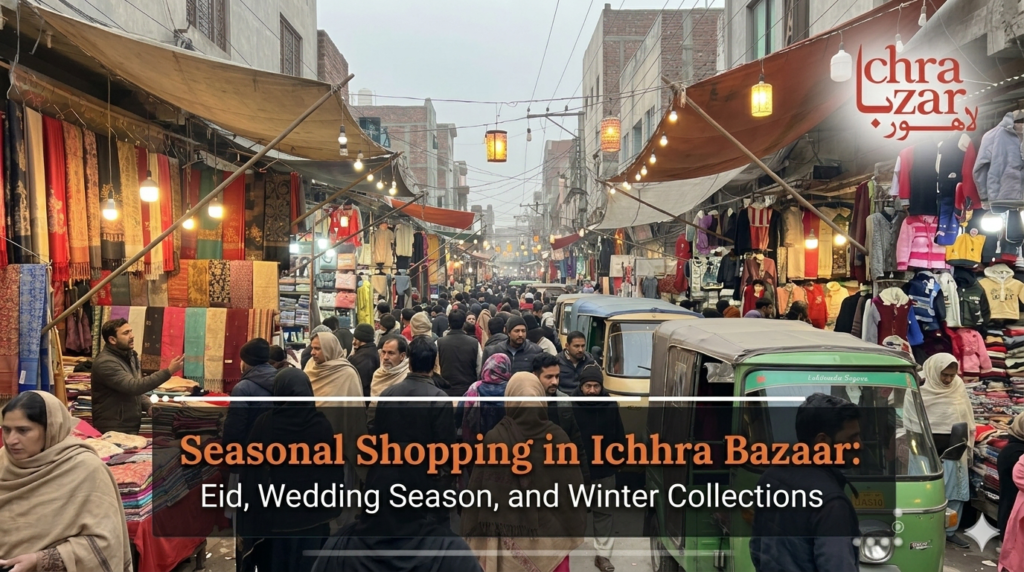
Ichhra Bazaar is not the same market in March that it is in October. The products change. The prices shift. The crowds grow and shrink. Even the vendor behavior is different. If you visit at the wrong time, you pay more and find less. If you visit at the right time, you get the best prices and the widest selection of the year. This guide covers all three major shopping seasons at Ichhra Bazaar. Each season has its own products, its own price behavior, and its own optimal buying window. Use it to plan every visit before you go.
How Ichhra Bazaar’s Seasonal Pricing Works
Before the season guides, you need to understand one key fact. Ichhra Bazaar’s vendors do not make their own stock. They buy it from wholesale markets like Azam Cloth Market in Lahore’s walled city.
When Pakistan’s major fabric brands release their seasonal collections, Ichhra Bazaar’s vendors buy from the same wholesale market. New stock arrives in Ichhra within two to three weeks. This happens for every season: lawn in spring, khaddar in winter, formals in wedding season.
The Price Arc Every Season Follows
Every seasonal product follows the same basic pattern:
- Arrival: Stock is fresh. Variety is at its widest. Prices are at their lowest. Vendors are flexible.
- Peak: Demand builds. Crowds grow. Popular designs start selling out. Vendors stop negotiating as much.
- Depletion: Popular items are gone. Remaining stock is limited. Prices may stay high or drop depending on the season.
Your goal is always to shop during the arrival phase. That is when you get the most choice at the lowest price.
Season 1: Eid-ul-Fitr Lawn Season (February – April)
Eid-ul-Fitr is Pakistan’s biggest fashion shopping event. It drives the busiest period in Ichhra Bazaar’s entire year. In 2026, Eid-ul-Fitr falls in late March. This makes February and early March the critical shopping window.
What Arrives During Eid Season
Lawn fabric and unstitched suits are the main product. Summer lawn collections arrive from late February. Digital-printed, rotary-printed, and embroidered lawn 3-piece sets fill the fabric section.
Ready-made kurtas and stitched suits arrive alongside fabric. These serve buyers who cannot wait for tailoring.
Accessories for Eid also increase. Jhumkay, bangle sets, embroidered clutches, and festive jewellery hit the jewellery lane from late February.
Children’s Eid clothing appears in the ready-made section from late February onward.
Eid Season Prices: From Good to Expensive
Late February Base pricing. Stock has just arrived. Vendors are flexible. A mid-range embroidered lawn 3-piece costs PKR 3,800 to PKR 5,500. Negotiating room is at its best.
First two weeks of March Still good. Full variety is available. Prices have not risen yet. Weekday visits in this window are the single best opportunity of the Eid season.
Third week of March through Ramzan Rising fast. Foot traffic increases sharply. That same mid-range lawn 3-piece now costs PKR 5,200 to PKR 5,800 from the same vendor. Popular designs start selling out.
Final two weeks before Eid Worst conditions. Prices are 20 to 35 percent above early-March levels. Vendors barely negotiate. Popular designs are gone. Parking is nearly impossible after 10 AM.
What to Avoid in Eid Season
Do not visit in the two weeks before Eid if you can avoid it. The price premium is 20 to 35 percent. That is a large, avoidable cost.
Do not shop on weekends during Ramzan. The crowds are at their worst and vendors have no reason to drop prices.
Do not buy economy lawn at peak time. It is the most price-sensitive category. Economy lawn that costs PKR 2,200 in February can reach PKR 3,200 the week before Eid.
Eid Season Crowd and Parking Guide
| Period | Crowd Level | Parking |
| February | Low | Easy all day |
| Early March (weekdays) | Low–Moderate | Available before noon |
| Late March (weekdays) | Moderate | Available before 11 AM |
| Ramzan weekends | Very High | Nearly impossible after 10 AM |
Best Time to Buy: Eid Season
Visit in the first two weeks of March. You get a full lawn variety. Prices are at base level. Vendors are flexible. Weekday mornings are the optimal time within this window.
Season 2: Wedding Season (September – November)
Pakistan’s wedding season peaks in October and November. September is the preparation month. This season drives demand across multiple categories at once bridal wear, formal suits, chiffon, Banarsi sarees, and bridal jewellery.
What Arrives During Wedding Season
Bridal and embroidered formal wear hits its annual peak in September and October. The bridal section in Ichhra’s inner lanes carries its widest selection of the year. Lehengas, formal maxis, gharara sets, and heavily embroidered occasion suits all arrive in volume.
Chiffon 3-piece sets for wedding guests arrive from September. Embroidered net, tissue, and organza formal suits fill the formal section.
Karandi and linen arrive in September. These semi-formal fabrics serve wedding-function guest wear. Cotton is too casual for weddings. Chiffon can be too formal. Karandi fills the gap perfectly.
Banarsi sarees and luxury formals arrive at shops like Al Fajar Cloth House in September and October. This is when their premium inventory is at its fullest.
Bridal jewellery and accessories costume sets, gold-plated necklaces, bangle collections, embellished clutches all increase from September onward.
Wedding Season Prices: The Three Phases
September The optimal window. Stock has arrived in full. Demand has not yet built up. Vendors are flexible. A mid-range embroidered chiffon 3-piece that costs PKR 9,000 in October is negotiable to PKR 7,500 to PKR 8,000 in September.
October Peak demand. The wedding season is fully active. Buyers are visiting from across Punjab. Vendor floor prices reach their seasonal high. That same chiffon piece now holds firm at PKR 8,500 to PKR 9,000. Variety is still wide, but prices have hardened.
November Demand continues, stock depletes. Popular designs in the bridal section start selling out. Prices stay high. Buyers who delay their shopping find fewer options.
December Season ends. Remaining formal stock is available at slightly lower prices. But variety is limited. December is only useful if you need one or two pieces without specific design requirements.
What to Avoid in Wedding Season
Do not complete your full bridal trousseau in October. The time required, the crowds, and the reduced negotiating room all work against you. Do it in September instead.
Do not buy chiffon in November if you have a specific colour or embroidery style in mind. The most popular designs sell through by late October. November leaves you choosing from what others did not want.
Do not tell vendors your wedding date during negotiation. It signals urgency. That immediately reduces your bargaining power. Keep your timeline to yourself.
Wedding Season Crowd and Parking Guide
| Period | Crowd Level | Parking |
| September (weekdays) | Moderate | Available before noon |
| October (weekdays) | Busy | Available before 10:30 AM |
| October (weekends) | High | Difficult after 10 AM |
| November | High through mid-month | Difficult on weekends |
Best Time to Buy: Wedding Season
Visit in the second or third week of September. Full bridal and formal inventory is available. October demand has not built yet. Vendors negotiate freely. Market conditions are comfortable.
Season 3: Winter Collection Season (October – January)
The winter season works differently from Eid and wedding seasons. It does not follow a demand-spike pattern. It follows a depletion pattern. This is the key distinction. In the Eid season, prices spike because everyone wants to buy before a fixed date. In the winter season, prices rise because popular designs sell out and become scarce. That changes your strategy entirely. The earliest window is always the best window for winter.
What Arrives During Winter Season
Khaddar unstitched fabric is the primary product. It arrives from the wholesale market in October. The full seasonal range embroidered khaddar, plain khaddar, printed khaddar appears in the first three weeks of October.
Khaddar with wool shawl dupatta sets are the premium winter purchase. These 3-piece sets combine khaddar shirt fabric, matching shalwar fabric, and a wool shawl dupatta. They arrive in October. Popular shawl colours and embroidery styles sell out faster than any other winter product.
Linen and karandi arrive in September and early October. Both peak in variety during September.
Velvet formal fabric arrives in December. It serves winter formal wear. Velvet 3-piece sets price at PKR 8,000 to PKR 22,000 in mid-range to premium quality.
Winter Season Prices: The Depletion Arc
October Base pricing, maximum variety. This is the best month for khaddar. All season designs are available. Prices are at their annual floor for winter categories. A mid-range embroidered khaddar 3-piece costs PKR 4,500 to PKR 6,500 with reasonable negotiating room.
November Variety narrows, prices rise. Popular khaddar designs start selling out. Prices on remaining popular designs rise 10 to 15 percent above October levels. Total variety is still reasonable, but the best-selling designs are depleting.
December Significant depletion. The most popular khaddar designs are largely gone. Remaining stock is weighted toward unpopular colours and embroidery styles. Prices on any remaining popular designs sit 15 to 25 percent above October base.
January Remnant stock only. This is end-of-season shopping. Selection is at its narrowest. Prices are not significantly lower than October on whatever remains. January khaddar only serves buyers with no specific design preferences.
What to Avoid in Winter Season
Do not delay a specific khaddar purchase until December. Popular embroidery styles and the khaddar-with-wool-shawl format sell out fast. If you have a specific design in mind, buy it in October. Do not shop for khaddar in January hoping for discounts. The selection is too narrow to justify the wait. Do not look for velvet fabric before December. It simply does not arrive until then.
Winter Season Crowd and Parking Guide
| Period | Crowd Level | Parking |
| October (weekdays) | Moderate | Available before 11 AM |
| November (weekdays) | Busy | Available before 10:30 AM |
| November (weekends) | Very High | Difficult after 10 AM |
| December | Moderate | Available most of the day |
| January | Low | Easy all day |
Best Time to Buy: Winter Season
Visit in the first three weeks of October. Full khaddar variety is available at base pricing. For khaddar-with-wool-shawl sets specifically, visit in the first two weeks of October. This format depletes faster than any other winter product.
Price Variation Summary Table
This table shows how Ichhra Bazaar prices move across the year. Use it before every visit to check where you fall in the seasonal arc.
| Product | Base Season | Price at Peak vs Base | Peak Season | Depletion Period |
| Lawn printed mid-range | Feb–early Mar | +20 to +35% | 2 weeks before Eid | Post-Eid |
| Lawn embroidered premium | Feb–early Mar | +25 to +40% | Final Ramzan week | Post-Eid |
| Chiffon / formal occasion | Aug–Sep | +15 to +25% | Oct (wedding peak) | Dec |
| Embroidered formal suits | Aug–Sep | +12 to +20% | Oct–Nov | Dec |
| Bridal lehengas | Sep | +10 to +18% | Oct–Nov | Dec |
| Khaddar embroidered | Oct | +15 to +25% over Oct | Nov–Dec | Jan |
| Khaddar with wool shawl | Oct | +20 to +30% over Oct | Nov | Dec |
| Cotton everyday wear | Year-round | Minimal variation | Stable | N/A |
| Karandi and linen | Sep–Oct | +10 to +15% over Sep | Nov | Dec |
For full PKR price breakdowns by fabric type and quality tier, see the Ichhra Bazaar unstitched suit price guide 2026.
Month-by-Month Buying Calendar
Save this calendar before every Ichhra Bazaar visit.
| Month | Best to Buy | Avoid Buying | Crowd Level | Parking |
| January | Cotton everyday wear | Khaddar (poor selection) | Low | Easy |
| February | Lawn (early season opens late Feb) | Khaddar (end of season) | Low–Moderate | Easy |
| March | Lawn best month of the year | Any winter fabric | Moderate (weekdays) | Available on weekday mornings |
| April | Lawn (pre-Eid pressure building) | Winter fabric | High–Very High | Difficult on weekends |
| May | Lawn (limited variety post-Eid) | Khaddar | Moderate | Available |
| June | Cotton, chiffon for everyday wear | Lawn (thinning out) | Low–Moderate | Easy |
| July | Cotton, early formal watching | Khaddar | Low | Easy |
| August | Chiffon, formal occasion wear | Lawn (off-season) | Moderate | Available |
| September | Karandi, linen, chiffon, bridal best wedding-season window | — | Moderate | Available on weekday mornings |
| October | Khaddar best month of the year, bridal and formal | — | Moderate–High | Available before 11 AM weekdays |
| November | Khaddar (narrowing), formal and bridal at peak | Delaying specific khaddar designs | High | Difficult on weekends |
| December | Velvet formal wear, cotton | Specific khaddar designs (depleted) | Moderate | Available |
Shopping Ichhra Bazaar Seasonally from Home
The seasonal patterns above apply to Ichra Bazar Lahore as well. Lawn listings peak in March. Wedding-season formals peak in September and October. Winter khaddar peaks in October.
For buyers outside Lahore, the platform removes the timing constraint. You do not need to be physically in Lahore during the optimal window. Browse current seasonal inventory and order with nationwide delivery from anywhere in Pakistan.
For Lahore-based buyers, use the platform to check what is in stock before visiting. It saves time and helps you enter the market with a clear purchasing plan.
Conclusion:
Ichhra Bazaar already gives you 20 to 40 percent below boutique retail pricing. Seasonal timing adds another 15 to 40 percent on top of that. Buy a lawn in early March. Shop bridal in September. Purchase khaddar in October. These three decisions alone save a buyer thousands of PKR across a full year of Ichhra Bazaar shopping without changing what they buy or where. Use the price variation table and monthly calendar before every visit. They are your two most practical seasonal tools. For the complete Ichhra Bazaar market guide with lane navigation and section layout, see the Ichhra Bazaar complete shopping guide.
For bridal-specific seasonal timing, see the Ichhra Bazaar bridal shopping complete guide.
For full PKR price breakdowns, see the Ichhra Bazaar unstitched suit price guide 2026.